Value matrix
W_V3.weight: (16, 64)
W_V3.T: (64, 16)Head 3 OV analysis
The attention report showed that Head 3 attends to max-valued number positions. This report asks what Head 3 writes into the output logits after reading that selected source token.
A natural first guess was that Head 3 might be a copy circuit: attend to the maximum digit, then boost the matching output digit. The OV matrix lets us test that directly.
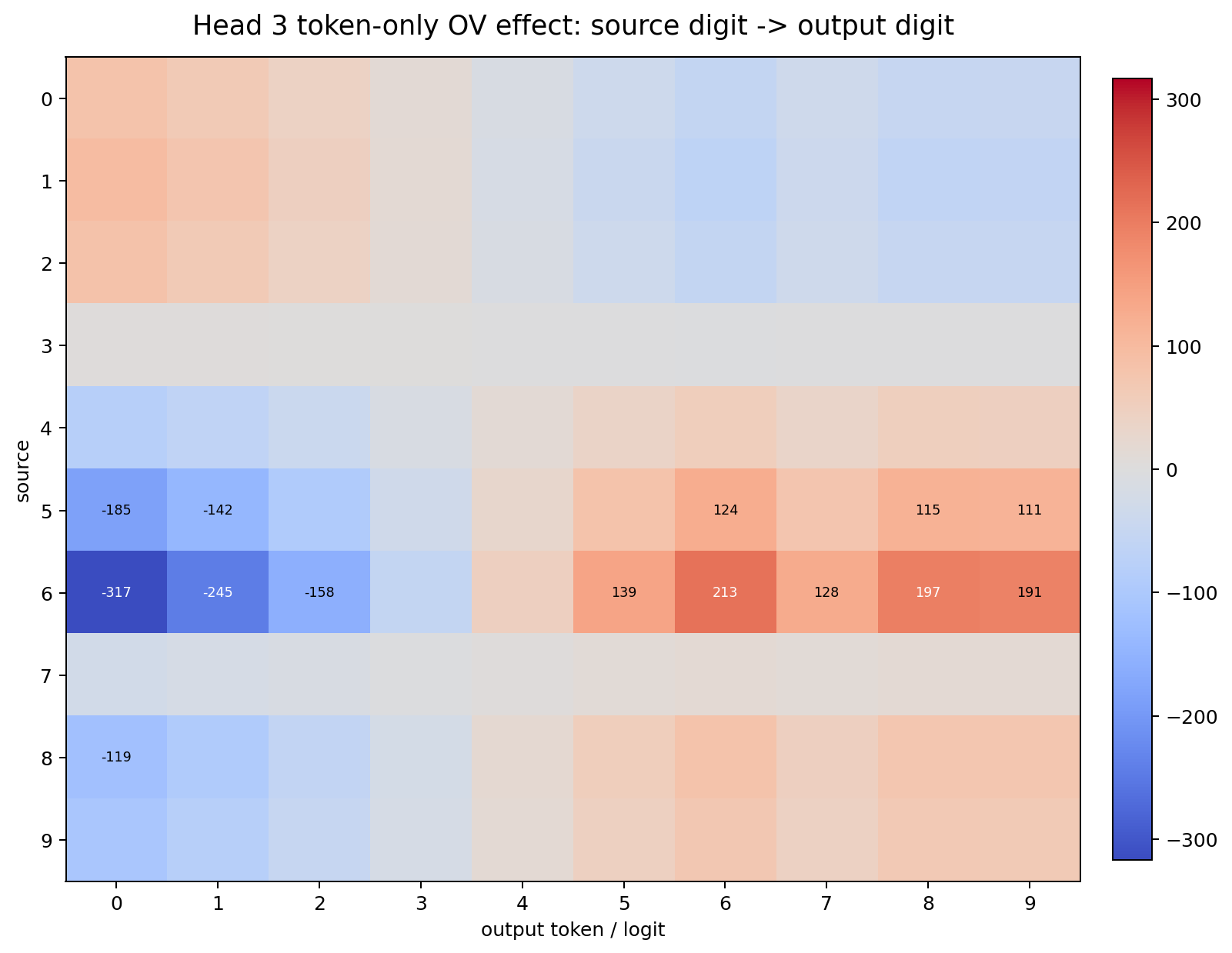
Head 3 does not look like a clean diagonal digit-copy circuit. In token-only OV, only 2 of 10 source digits have positive diagonal margins.
With d_model = 64, n_heads = 4, and
d_head = 16, Head 3 uses the final slice of the concatenated
attention output.
W_V3.weight: (16, 64)
W_V3.T: (64, 16)Head 3 slice: 48:64
W_O3: (16, 64)unembed.weight: (14, 64)
unembed.weight.T: (64, 14)OV_logits_3 = W_V3.T @ W_O3 @ unembed.T
(64,16) @ (16,64) @ (64,14) = (64,14)tok_embed[d] @ OV_logits_3
(10,64) @ (64,14) = (10,14)Tests whether digit identity alone is copied into output logits.
pos_embed[pos] @ OV_logits_3
(5,64) @ (64,14) = (5,14)
Tests whether Head 3 writes position-dependent output biases.
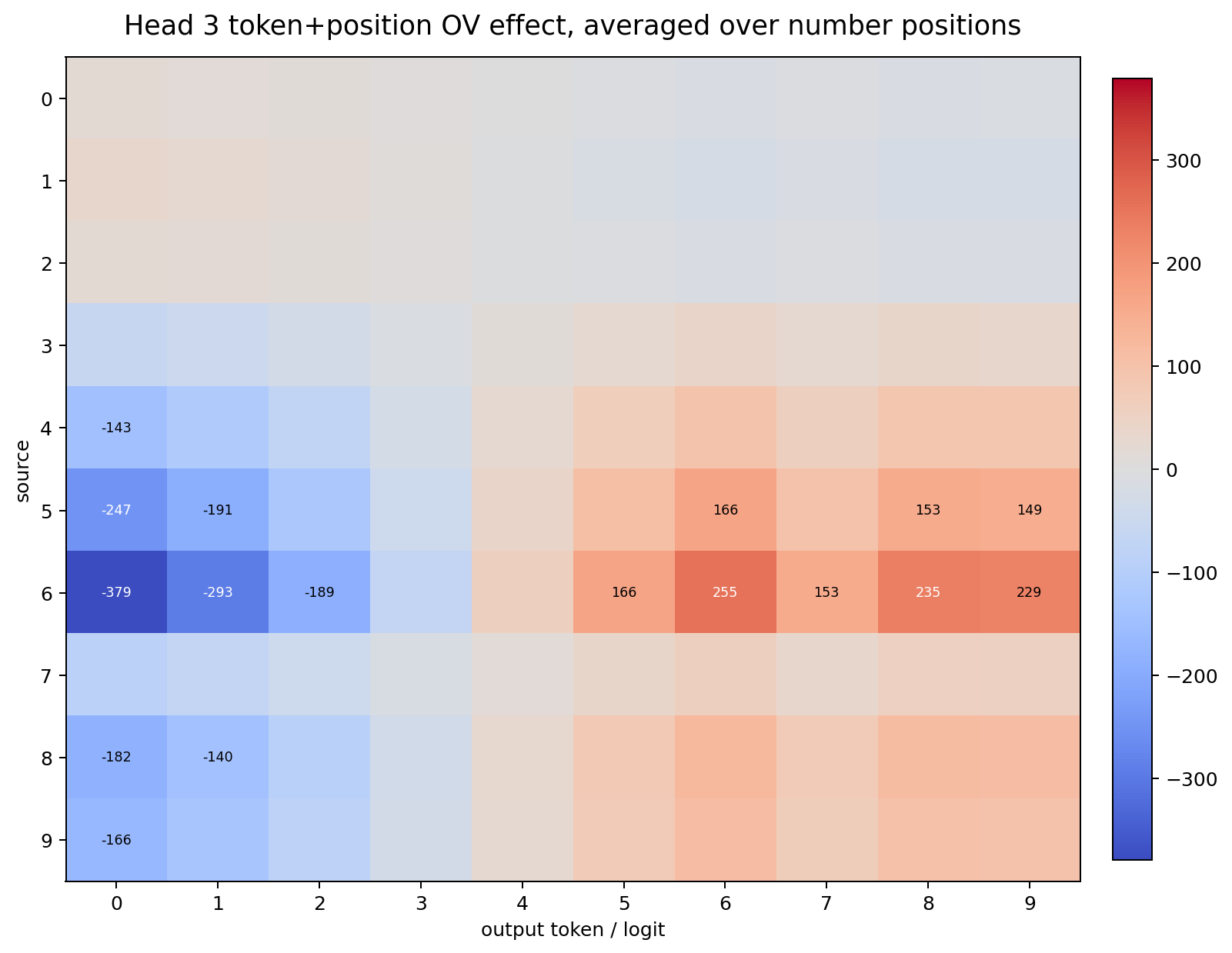
(tok_embed[d] + pos_embed[pos]) @ OV_logits_3
(5,10,64) @ (64,14) = (5,10,14)
Matches the real residual vector at number source positions.
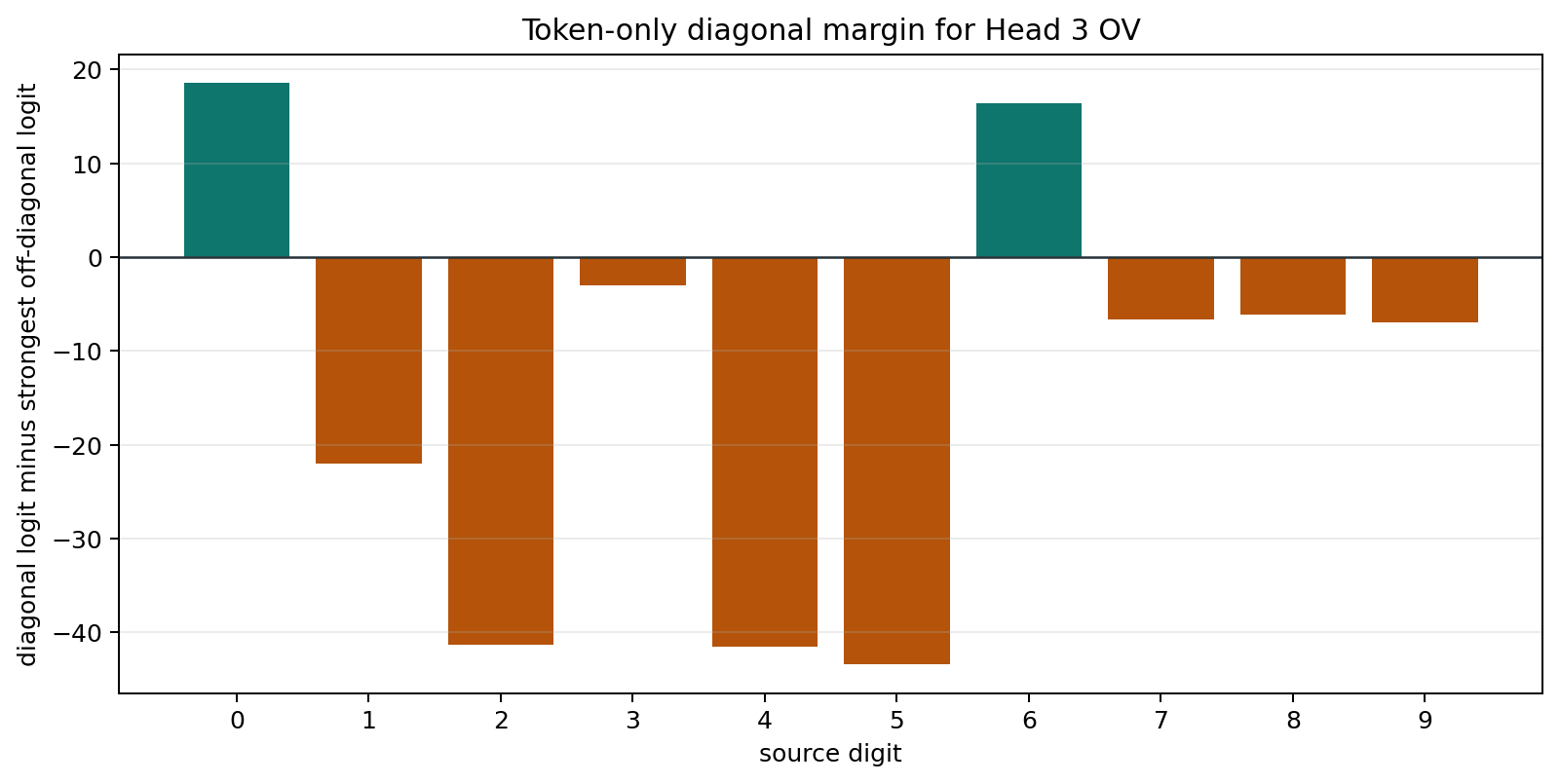
In a clean copy circuit, the row argmax would be
[0,1,2,3,4,5,6,7,8,9]. Instead, token-only Head 3 gives:
[0, 0, 0, 0, 6, 6, 6, 6, 6, 6]
That means source digits 0-3 most strongly push output
digit 0, and source digits 4-9 most strongly
push output digit 6, before considering the rest of the
model's residual and other heads.
Adding position embeddings produces almost the same row-argmax pattern at
every number position: low digits point to 0, and most higher
digits point to 6. This suggests Head 3's role is more subtle
than direct answer copying.
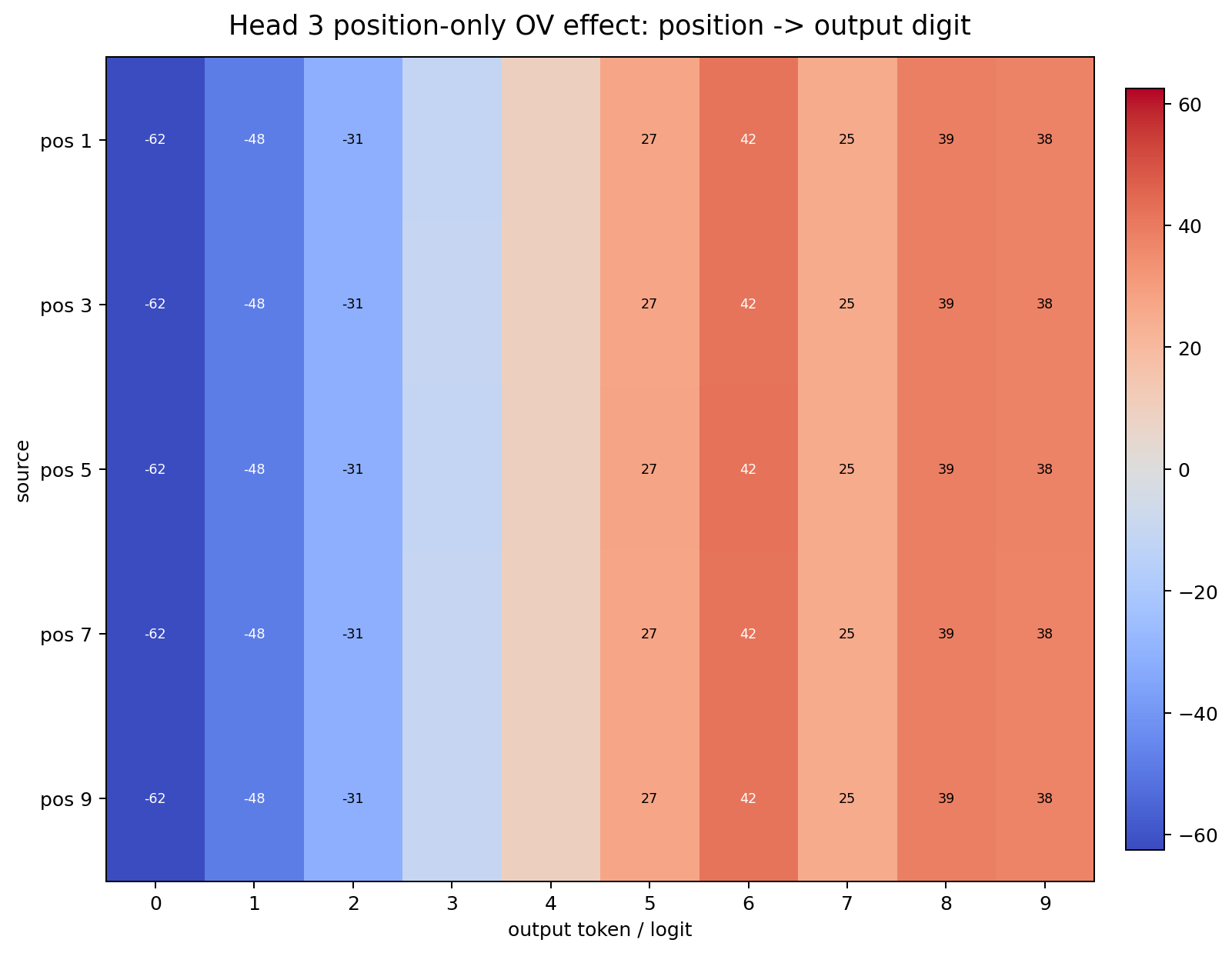
The current evidence says: Head 3 is probably a max selector on the QK side, but not the complete answer-copy circuit on the OV side.
The next useful step is per-component logit attribution at [ANS].
That will show whether Head 3 provides a coarse high-vs-low signal, while
another component or the residual stream separates the exact digit.